When developing comprehensive lighting plans for commercial estates, corporate campuses, or luxury hospitality venues, automation is no longer an optional luxury. It is a strict operational requirement. As property managers and landscape architects seek ways to reduce energy consumption while maintaining continuous security, the integration of intelligent sensors has become paramount. At Keyida, our 25 years of experience in the OEM and ODM manufacturing sector have taught us that adding smart functionality requires precise engineering. Integrating dusk-to-dawn sensors into architectural lighting structures must be done without compromising the fixture’s aesthetic or its weather resistance. For our B2B partners, understanding the mechanics behind these sensors is crucial for specifying the correct hardware for large-scale projects. Here is a technical look at how we engineer reliable, automated photocells into our robust luminaires.
The Core Technology Inside Photocell Sensors
To appreciate the functionality of a dusk-to-dawn fixture, we must first examine the internal components. The heart of this automation is a photocell, specifically a light-dependent resistor (LDR) or a more advanced solid-state photodiode. These electronic components are highly sensitive to ambient ultraviolet and visible light. During daylight hours, the solar radiation hitting the sensor causes its internal electrical resistance to drop significantly. This low resistance state keeps the internal electrical circuit open, preventing voltage from reaching the LED driver.
As the sun sets and ambient lux levels decrease, the sensor’s resistance gradually increases. Once the ambient light drops below a specific, pre-calibrated threshold—typically around 10 to 30 lux—the internal resistance peaks. This electrical shift triggers a solid-state relay or micro-switch, closing the circuit and illuminating the luminaire. This simple yet highly effective mechanism ensures that pier mount lights only consume power when natural illumination is insufficient. By eliminating the need for mechanical timers, which require constant seasonal adjustment, photocells provide a reliable “set and forget” solution that commercial facility managers highly value.
Note: Commercial photocells adopt light hysteresis circuits to prevent frequent flickering caused by temporary light changes. The dawn cut-off illuminance ranges from 50 to 150 lux, which is much higher than the dusk trigger threshold of 10 to 30 lux set on Keyida outdoor lamp sensors. Most factory default photocell settings shut down lights at 50–80 lux, while 100–150 lux options are customized for fully open, high-bright commercial plazas.
Practical Scenarios for Automated Outdoor Pier Mount Lights
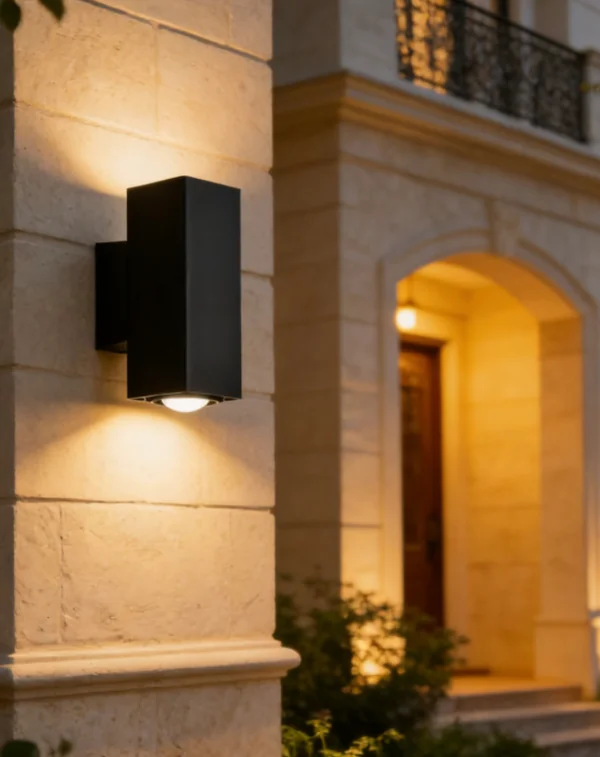
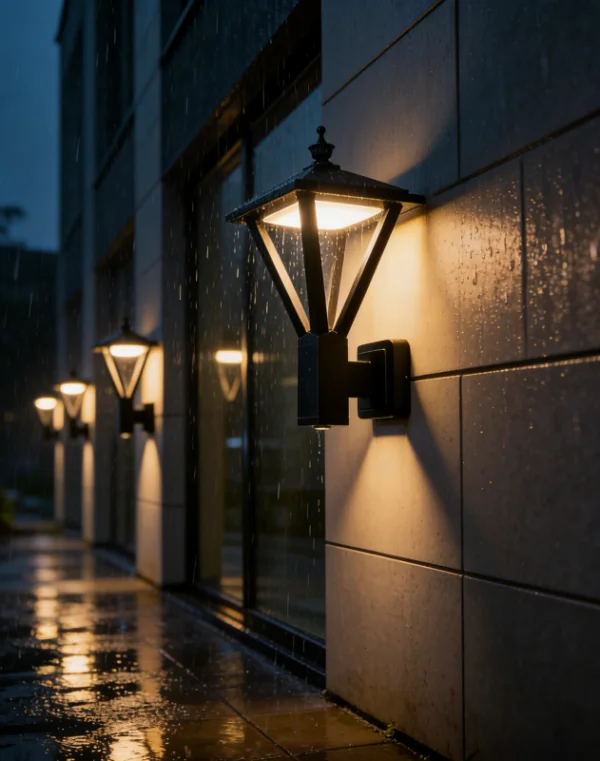
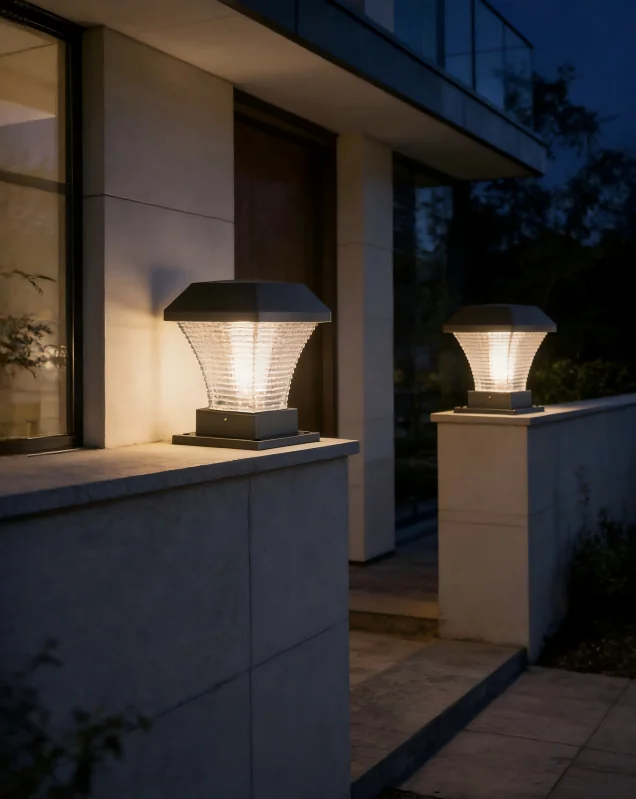
The theoretical benefits of photocell technology translate directly into tangible advantages in real-world commercial applications. Consider a sprawling gated residential community or a high-traffic hotel entrance. These environments consistently utilize structural columns and stone pillars to define their perimeters and entryways. By outfitting these architectural elements with automated outdoor pier mount lights, property developers can guarantee a seamless transition into night mode without any human intervention.
In practical terms, this automation serves two primary purposes: safety and energy conservation. From a security standpoint, well-lit perimeters naturally deter unauthorized access. If a property relies on manual switches or unadjusted mechanical timers, a sudden afternoon storm or an early winter sunset can leave critical entry points in complete darkness. A photocell reacts in real-time to the actual environmental conditions, ensuring consistent visibility. Conversely, from an energy management perspective, these sensors prevent the wasteful burning of electricity during early morning daylight hours. For B2B contractors outfitting a site with dozens or even hundreds of fixtures, this automated efficiency dramatically reduces the total operational cost of the lighting array over its lifespan.
Engineering Reliable Sensors for Extreme Environments
While the core concept of a photocell is straightforward, engineering it to survive harsh outdoor environments requires significant manufacturing expertise. The primary challenge we face is protecting the sensitive electronic components from moisture, dust, and extreme temperature fluctuations. A compromised sensor will fail, leading to a fixture that either stays on continuously or refuses to turn on at all.
To prevent this, the physical integration of the photocell must meet strict ingress protection standards. We design the sensor housing to achieve an IP65 or higher rating. This involves using precision-molded silicone gaskets and UV-resistant polycarbonate lenses that shield the photodiode while still allowing accurate light measurement. Furthermore, our engineering team must account for “cycling”—a frustrating phenomenon where a fixture’s own light output, or a passing car’s headlights, tricks the sensor into thinking it is daytime. To combat this, we utilize advanced circuitry with a built-in time delay. This ensures the sensor only responds to sustained changes in ambient light, completely ignoring brief flashes from vehicular traffic or reflective surfaces.
Partnering for Custom Manufacturing Excellence
Delivering commercial-grade reliability demands a manufacturing partner who controls the entire production process. As an established OEM and ODM provider, we do not simply assemble off-the-shelf parts. We engineer our exterior luminaires from the ground up. Our production facilities utilize premium die-cast aluminum to form the foundational structure of every fixture. This heavy-duty metal provides exceptional heat dissipation for the LED arrays and structural integrity against physical impacts.
Once the raw aluminum is cast and precision-machined to accommodate the photocell components, we apply a multi-step electrostatic powder coating. This rigorous finishing process ensures the metal is impervious to rust, coastal salt spray, and intense solar radiation. The result is a beautifully finished luminaire that houses sophisticated, weather-tight automation technology. For landscape architects and electrical distributors, specifying these engineered solutions means delivering long-term value to the end user.
Conclusion
The integration of dusk-to-dawn photocells transforms standard architectural fixtures into intelligent, self-regulating systems. Understanding the engineering behind these sensors—from precise resistance calibration to heavy-duty weatherproofing—allows B2B professionals to make informed purchasing decisions. When outfitting your next commercial project, you need hardware that performs flawlessly without constant oversight.
At Keyida, we are dedicated to providing the technical expertise and the robust manufacturing capabilities required to bring your ambitious lighting designs to life. Whether you need a standard catalog order or a fully customized, automated lighting solution, our team is ready to deliver. By combining advanced sensor technology with our uncompromising build quality, you ensure that your commercial outdoor spaces remain secure, efficient, and beautifully illuminated night after night.