Outdoor lighting projects often use several low-power fixtures across gardens, paths, entrances, and landscape areas. Transformer sizing matters because the selected capacity must match the connected load while leaving a reasonable operating margin. For projects using garden spike lights, the calculation should consider fixture wattage, quantity, cable length, voltage drop, and future expansion instead of relying only on a simple wattage total.
A clear calculation method helps contractors, lighting retailers, and project buyers select suitable power equipment before installation. The aim is to avoid both undersized transformers and unnecessarily large units. Careful planning can also make installation and later maintenance easier.
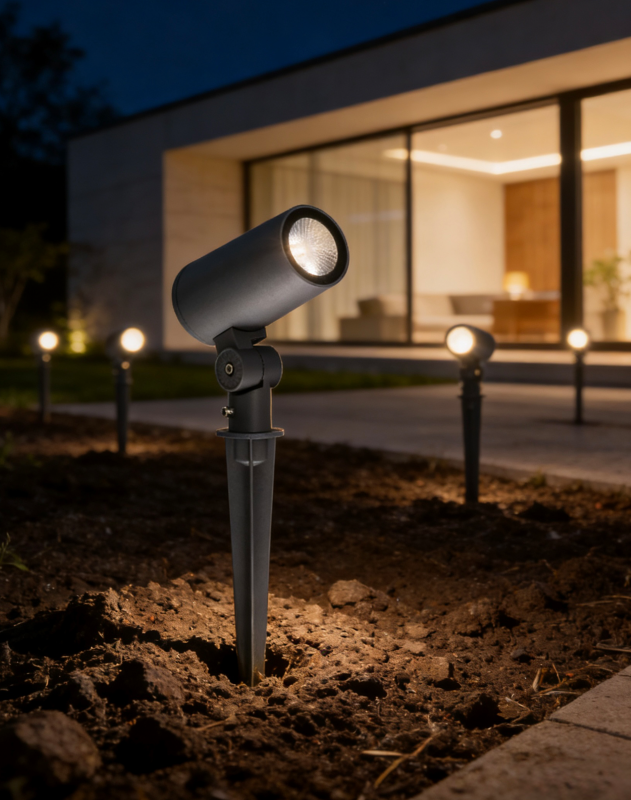
Start With the Total Fixture Load
First, identify the rated power of every fixture on the circuit. Multiply the wattage of one fixture by the total quantity. If a project uses 20 fixtures rated at 5W each, the connected lighting load is 100W.
This figure is only the starting point. The transformer should not be selected at exactly 100W because real installations may involve driver losses, voltage variation, and later additions. Leaving some reserve capacity reduces the chance of operating the transformer near its upper limit for long periods.
For B2B projects, we also recommend checking whether all fixtures use the same voltage and driver type. Mixed products can create confusion during installation. A clear product schedule helps contractors confirm power demand before cable routing and transformer selection.
Add a Practical Capacity Margin
A common project approach is to add a reserve margin above the calculated fixture load. The exact margin depends on transformer type, project conditions, and local electrical practice. For many landscape projects, around 20% to 30% can be used as a planning reference rather than a fixed rule.
Using the earlier 100W example, adding a 25% reserve gives a target capacity of 125W. The project team can then choose the nearest suitable transformer size above that figure. This leaves extra room for normal operating variation and limited expansion.
When garden spike lights are installed in several zones, dividing the load between transformers may be more practical than using one large unit. Separate zones can simplify troubleshooting and later changes, especially in hotels, villas, retail spaces, and commercial landscapes.
Check Voltage Drop and Cable Distance
Transformer capacity alone does not determine system performance. Cable length also matters, especially when fixtures are far from the power source. Longer cable runs can create voltage drop, which may affect brightness or driver performance.
Project teams should review cable size, route length, total current, and the distance to the furthest fixture. Where the run is long, increasing cable size or dividing the circuit into shorter branches may be more practical than simply increasing transformer capacity.
This step is important for outdoor stake lighting because landscape fixtures are often distributed across wide areas. Paths, planting beds, walls, and trees may require different cable routes. A simple site layout prepared before installation can help the contractor estimate cable demand and power distribution more accurately.
Use the Fixture Specification in the Calculation
Product specifications should be checked before finalizing the transformer. At Keyida, our E0336 outdoor light uses an Epistar COB 5W LED chip with a KEDA Driver. Its input voltage is 85–265V AC at 50/60Hz, so it is designed for direct AC input rather than a low-voltage transformer circuit.
The E0336 uses a die-casting aluminum housing with a glass lampshade. Its size is Ø55 × L115 × H320 mm. It has an IP54 rating and a three-year warranty. These details matter because the electrical design must match the actual input requirements of the fixture.
This distinction is important for buyers comparing low-voltage and mains-voltage products. If a fixture already accepts 85–265V AC, the project may not need a step-down transformer for that fixture. The electrical plan should instead focus on circuit protection, cable specification, switching method, and local installation requirements.
Plan for Zoning and Future Expansion
Commercial landscape projects often change after the first design stage. New planting areas, signs, entrance features, or display zones may be added later. Leaving some electrical capacity can make these changes easier to manage.
Reserve capacity should still remain reasonable. Oversizing a transformer too much can increase equipment cost without adding useful value. The aim is to match transformer size to the calculated load, expected reserve, and actual project layout.
For projects with several lighting zones, separate circuits can also help with timing control and maintenance. One zone can remain active while another is serviced. This arrangement may suit hotels, commercial properties, garden centers, and building-material retail projects.
Match the Calculation to the Actual Product
Transformer sizing begins with a simple formula, but the final decision should consider more than total wattage. Fixture input voltage, driver design, cable distance, zoning, and reserve capacity all affect the electrical plan. A 5W fixture does not automatically mean the project requires a low-voltage transformer.
At Keyida, we design and produce modern outdoor lighting for B2B customers, including OEM and ODM projects. When buyers evaluate outdoor stake lighting, checking the electrical specification first can prevent unnecessary transformer selection and make project planning more accurate.
A practical process is to confirm fixture input requirements, calculate total connected load, add a suitable reserve, check cable distance, and review zoning. This gives project teams a clearer basis for selecting power equipment while keeping installation, expansion, and maintenance easier to manage.