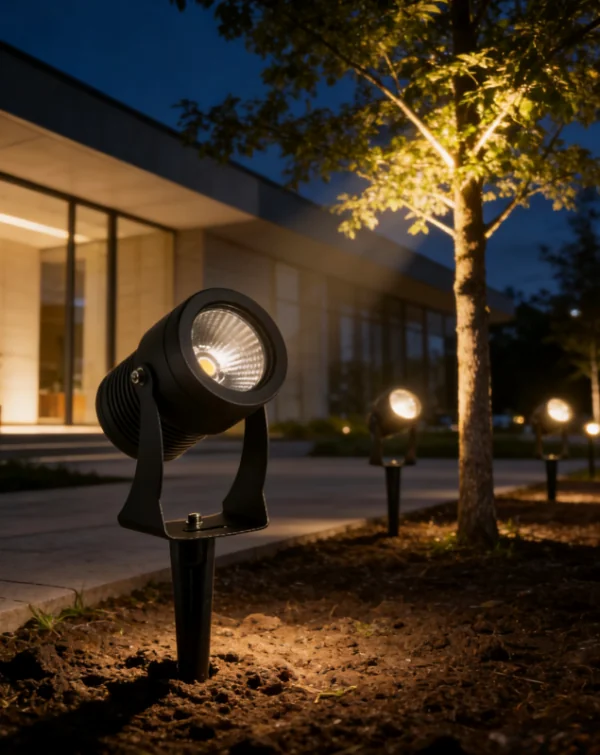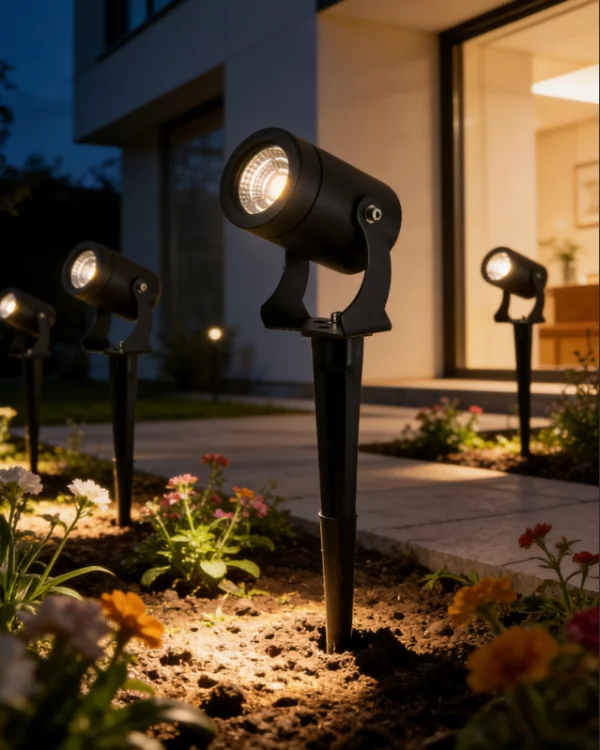
Designing exterior layouts for commercial real estate and luxury resorts requires meticulous financial planning. Sourcing managers and electrical contractors face a critical decision during the initial blueprint phase. They must choose between traditional low-voltage halogen systems and modern solid-state pathway lighting. While halogen fixtures historically offered lower purchasing prices, their ongoing operational liabilities tell a different story. As a premier global manufacturer with 25 years of dedicated industry experience, we at Keyida engineer high-performance landscape fixtures tailored to complex commercial environments. We operate a 7,000m² production plant and deliver durable, certified lighting products to global B2B partners. This 5-year total cost analysis compares financial and performance gaps between the two lighting solutions. It explains how proper lighting choices cut long-term property operation expenses and raise investment returns.
The True Energy Cost of LED Path Lights vs. Halogen
To understand the actual cost of operation, let us examine a highly practical commercial scenario. Imagine a corporate estate requiring a network of $200$ pathway fixtures. These fixtures operate for 10 hours per night, 365 days per year. A standard halogen landscape fixture consumes approximately 35 W of electrical power. Conversely, our high-efficiency LED path lights deliver equivalent or superior lumen output utilizing only 6 W of energy. We can compare the annual power costs via simple calculation. The halogen system draws a massive 7,000 W continuously. Over a single year, this amounts to 25,550 kWh. At an average commercial electricity rate of $0.15 per kWh, the annual utility cost for halogen illumination totals $3,832.50. Over a strict 5-year period, the operational cost scales to an astonishing $19,162.50. In sharp contrast, the advanced solid-state system consumes only 1,200 W per hour. This equals just 4,380 kWh annually, costing a mere $657.00 per year. Over a 5-year span, the cumulative electricity cost is just $3,285.00. This single operational shift results in direct energy savings of $15,877.50 for the property manager.
Note: All figures are calculated under ideal constant operating conditions, without accounting for circuit loss, transformer energy consumption and seasonal lighting hour changes. The $0.15/kWh electricity price applies to North American commercial scenarios only.
Relamping Demands and Ongoing Maintenance Labor
The upfront cost of halogen bulbs makes up just a small share of total commercial lighting operating expenses. Standard halogen lamps have a relatively short expected operational life of approximately 2,000 to 5,000 hours. In a continuous-use commercial environment running 3,650 hours annually, almost every single halogen bulb will fail. They will require replacement within 12 to 18 months. This short lifespan creates an exhausting, constant cycle of maintenance requests.
For our 200-fixture property, facility managers must expect to replace roughly 200 bulbs annually. You must factor in the cost of replacement halogen bulbs and the skilled labor hours required to swap them out safely. Assuming a conservative labor rate of $50.00 per hour, replacing these bulbs costs $2,500.00 annually. Over 5 years, labor alone adds $12,500.00 to the facility budget, alongside roughly $2,000.00 in replacement lamp inventory. We purposefully design our modern landscape fixtures to eliminate this costly maintenance loop entirely. Equipped with 50,000-hour LED modules, our commercial lighting fixtures carry a formal 3-year warranty. In regular commercial operating environments, they deliver a practical service lifespan of 5 to 6 years with no need for bulb replacement. By shifting to long-lasting fixtures, developers entirely erase recurring labor fees from their operational spreadsheets.
Infrastructure and Copper Cable Selection
Another highly expensive, often hidden drawback of low-voltage halogen systems is the physical infrastructure required to distribute power safely. Because halogen bulbs draw significant electrical current, voltage drop is a constant concern over long distances. To combat this electrical resistance, installation contractors must purchase thick, heavy-gauge copper cabling. This requirement significantly inflates raw material costs during the initial build.
Furthermore, high-power halogen lighting circuits demand multiple heavy-duty step-down transformers to carry large electric loads without overheating. A full 7 000W halogen lighting system requires at least nine 1 000W transformers distributed across different site zones. Per electrical industry rules, transformers can only run at 80% of their rated power for continuous outdoor use, so multiple high-cost transformers are mandatory. This complicated wiring layout makes construction drawings harder to design and creates more positions prone to circuit faults. Our LED path lights totally change this installation logic. These low-wattage lamps draw tiny electric currents, which greatly cuts voltage drop along cables. Installers may use thinner, softer copper wires and set up far fewer transformers on site. This simplified electrical layout drastically lowers upfront raw material expenses for commercial projects. It ultimately saves thousands of dollars during the critical construction and trenching phases of a major development project.
Note: The 9-unit transformer calculation is based on the 80% continuous load limit of standard landscape transformers, a universal rule for outdoor commercial lighting construction.
Material Durability and Manufacturing Excellence
Sourcing reliable, long-lasting hardware is the ultimate way to guarantee a strong return on investment. At our advanced production facility, we focus exclusively on engineering landscape solutions that survive severe real-world challenges. We construct our heavy-duty bollard lights from premium aluminum alloys to prevent structural decay. To ensure decades of reliable service, our rigorous pre-painting sanding process creates microscopic texture in the bare aluminum. This critical step ensures that our specialized anti-corrosion primer and protective powder coating bond flawlessly. This multi-layer defense completely prevents moisture ingress, salt-spray oxidation, and peeling paint, even in humid coastal areas. We also heavily prioritize long-term servicing efficiency for commercial property managers. We design our modern commercial fixtures with independent, easily replaceable internal components. If an electronic driver eventually fails, maintenance crews can replace the internal parts in mere minutes without unmounting the entire housing. To give our global partners a strong market advantage, we launch new proprietary molds quarterly. Every high-performance fixture we manufacture holds CE, RoHS, and SAA certifications, ensuring immediate compliance and smooth import processes. Sourcing managers and landscape architects can partner with us to equip your next development project with illumination solutions built strictly for commercial longevity