We at Keyida develop outdoor lighting systems for B2B projects that require stable installation, consistent optical performance, and long-term environmental resistance. Motion sensor integration is widely used in building facades, hotel projects, and commercial entrances. This article explains installation steps while also introducing design considerations from an engineering perspective.
Planning for Outdoor Wall Lights Motion Sensor Installation
When working with outdoor wall lights motion sensor, we begin by reviewing the installation environment. At Keyida, we assess wall material, mounting height, and wiring access before any physical setup begins. Most installations involve concrete or brick surfaces, which require expansion anchors for stability.
Power isolation is confirmed before work starts. We also map sensor detection zones to avoid interference from nearby reflective surfaces or moving objects such as trees or traffic areas.
Electrical Preparation in Hotel Exterior Lighting Projects
For hotel exterior lighting, wiring planning is essential before installation. We typically guide installers to pre-route cables through protective conduits to support long-term durability in outdoor conditions. Keyida designs lighting products with aluminum housings and tempered glass covers, which support heat dissipation and structural stability. Voltage compatibility must be checked carefully before connecting to the AC supply, especially in international hotel projects using different grid standards.
Mounting Structure and Alignment Process
Surface preparation directly affects installation accuracy. The wall surface should be cleaned, leveled, and checked for hidden pipelines before drilling begins. This step helps avoid structural damage and ensures safe installation.
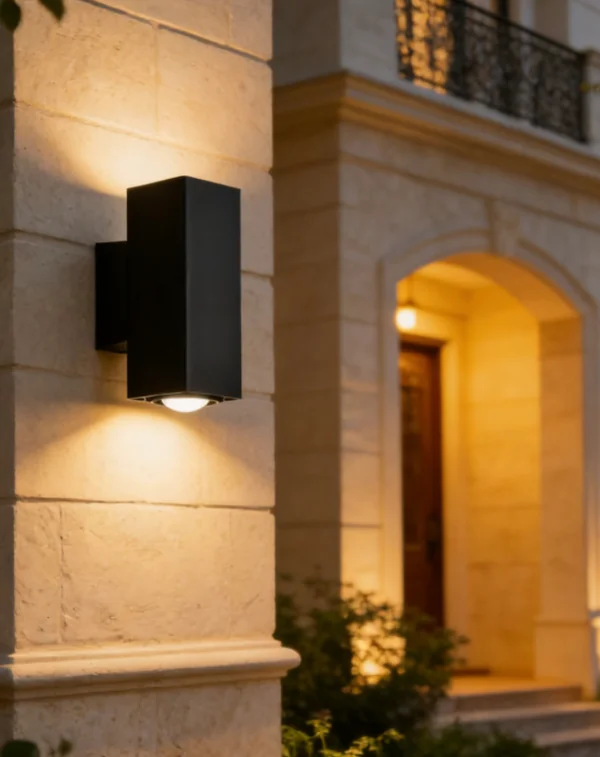
For models like Outdoor Wall Lights Motion Sensor – A0696, alignment templates are often used. The fixture size Ø65 × W100 × H160 mm requires precise positioning to maintain uniform lighting direction after installation.
Installation of Keyida A0696 Sensor Lighting System
The Keyida A0696 model uses a die-casting aluminum housing with tempered glass cover, designed for stable outdoor use. Inside, it integrates a CREE COB 2×5W LED chip and a KEDA driver, operating within 85–265V AC input range at 50/60Hz.
During installation, we recommend securing the base bracket first, then adjusting the fixture body before final tightening. This allows alignment correction to match architectural lighting direction requirements.
Wiring Connection and Safety Grounding Process
Electrical wiring is performed only after confirming full power shutdown. For outdoor wall lights motion sensor, installers connect live, neutral, and grounding wires according to local electrical standards.
At Keyida, many systems include stable driver modules that help regulate voltage fluctuations. Proper insulation at connection points is essential to prevent moisture-related risks in outdoor environments.
Sensor Configuration and Detection Calibration
After installation, the motion sensor must be tested. Detection range and response timing should be adjusted based on site conditions such as corridor width or entrance distance.
In hotel exterior lighting applications, sensor sensitivity is often set lower near high-traffic areas to avoid continuous triggering. This improves energy efficiency while maintaining functional illumination when needed.
Lighting Performance Testing and Beam Adjustment
Once powered, installers should evaluate brightness distribution and beam angle. The A0696 produces a soft glow effect designed to create a welcoming atmosphere while maintaining visibility.
The tempered glass cover helps diffuse light evenly. Adjustments can be made by slightly rotating the fixture body before final lock-in to achieve consistent façade lighting coverage.
Product Integration in Architectural Projects
In B2B lighting projects, Keyida systems are often integrated into broader architectural lighting plans. Our products are designed for modular installation, allowing contractors to scale lighting layouts across multiple building zones.
For outdoor wall lights motion sensor, integration with smart building systems is also possible in larger projects, depending on control system compatibility.
Maintenance considerations after installation
After installation, periodic inspection is required to help maintain stable performance.
LED drivers and sensor modules should be checked for dust accumulation or moisture exposure.
Keyida designs A0696 with replaceable LED components, which simplifies maintenance without removing the full fixture from the wall. This reduces long-term service complexity for commercial buildings.
Durability and Environmental Adaptation
Outdoor lighting must withstand temperature changes, humidity, and rainfall. The A0696 uses a die-casting aluminum housing and IP65-rated protection design, making it suitable for long-term exterior applications.
In hotel exterior lighting projects, durability is especially important due to continuous nighttime operation and guest-facing visibility requirements.
Conclusion: Installation Approach for Long-term Reliability
At Keyida, we view installation as a combination of structural preparation, electrical safety, and functional calibration. Each step directly influences the stability of motion sensor lighting systems in real environments.
Whether using outdoor wall lights motion sensor or integrating fixtures into hotel projects, proper installation ensures consistent performance and reduced maintenance needs over time.